Typed entity structs for the nros RMW C surface. More...
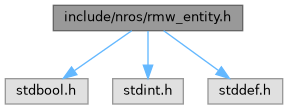
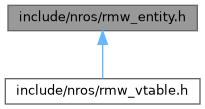
Go to the source code of this file.
Data Structures | |
| struct | rmw_byte_span_t |
| struct | rmw_client_t |
| struct | rmw_gid_t |
| struct | rmw_message_info_t |
| struct | rmw_message_type_support_t |
| struct | rmw_mut_byte_span_t |
| struct | rmw_network_flow_endpoint_t |
| struct | rmw_node_t |
| struct | rmw_publisher_options_t |
| struct | rmw_publisher_t |
| struct | rmw_qos_profile_t |
| struct | rmw_service_t |
| struct | rmw_service_type_support_t |
| struct | rmw_session_options_t |
| struct | rmw_session_property_t |
| struct | rmw_session_t |
| struct | rmw_subscription_options_t |
| struct | rmw_subscription_t |
| struct | rmw_topic_endpoint_info_t |
Typedefs | |
| typedef void(* | rmw_content_filter_visit_fn) (void *ctx, const char *expression, const char *const *parameters, size_t parameter_count) |
| typedef bool(* | rmw_network_flow_endpoint_visit_fn) (void *ctx, const rmw_network_flow_endpoint_t *endpoint) |
| typedef int64_t | rmw_time_point_value_t |
Functions | |
| rmw_ret_t | nros_rmw_qos_incompatibility_mask (rmw_qos_profile_t offered, rmw_qos_profile_t requested, rmw_qos_compatibility_type_t *compatibility, uint32_t *clash_mask) |
| rmw_ret_t | rmw_compare_gids_equal (const rmw_gid_t *gid1, const rmw_gid_t *gid2, bool *result) |
| rmw_ret_t | rmw_qos_profile_check_compatible (rmw_qos_profile_t publisher_profile, rmw_qos_profile_t subscription_profile, rmw_qos_compatibility_type_t *compatibility, char *reason, size_t reason_size) |
Detailed Description
Typed entity structs for the nros RMW C surface.
Same shape as upstream rmw.h's rmw_publisher_t / rmw_subscription_t family: visible metadata + a void * data tail (named backend_data here). No generic-handle typedef.
Lifetime rule. All const char * string fields are borrowed pointers — the storage pointing at them is owned by the caller (the runtime) and must outlive the entity. Backends never free or reallocate these strings; they hold them as-is for the entity's lifetime.
ABI commitment. These structs are part of the public ABI. Adding or reordering fields is a major version bump. Backends compile against this header and consumers compile against backend libraries — both sides must agree on the layout.
Forward-compat reserved bytes. Each entity carries an explicit _reserved[N] byte array sized to fill the natural alignment slot before backend_data. New fields up to N bytes can be added later without changing the struct's overall size or any field's offset after backend_data. Backends and runtime must zero the reserved bytes; the runtime relies on them being zero on read.
No-alloc + no-std preserved. No struct here owns heap-allocated storage. All metadata is either inline POD or a borrowed pointer.
Macro Definition Documentation
◆ NROS_RMW_DURABILITY_SYSTEM_DEFAULT
| #define NROS_RMW_DURABILITY_SYSTEM_DEFAULT 0 |
Durability policy values for rmw_qos_profile_t::durability.
◆ NROS_RMW_DURABILITY_TRANSIENT_LOCAL
| #define NROS_RMW_DURABILITY_TRANSIENT_LOCAL 1 |
◆ NROS_RMW_DURABILITY_UNKNOWN
| #define NROS_RMW_DURABILITY_UNKNOWN 3 |
◆ NROS_RMW_DURABILITY_VOLATILE
| #define NROS_RMW_DURABILITY_VOLATILE 2 |
◆ NROS_RMW_DURATION_INFINITE_MS
| #define NROS_RMW_DURATION_INFINITE_MS UINT32_MAX |
Explicit infinite spelling for the u32-ms duration fields (phase-301, issue 0241). Semantically identical to 0 (no check) but lets a caller distinguish "I mean infinite" from "I left it unset".
◆ NROS_RMW_HISTORY_KEEP_ALL
| #define NROS_RMW_HISTORY_KEEP_ALL 2 |
◆ NROS_RMW_HISTORY_KEEP_LAST
| #define NROS_RMW_HISTORY_KEEP_LAST 1 |
◆ NROS_RMW_HISTORY_SYSTEM_DEFAULT
| #define NROS_RMW_HISTORY_SYSTEM_DEFAULT 0 |
History policy values for rmw_qos_profile_t::history.
◆ NROS_RMW_HISTORY_UNKNOWN
| #define NROS_RMW_HISTORY_UNKNOWN 3 |
◆ NROS_RMW_QOS_POLICY_AVOID_ROS_NAMESPACE_CONVENTIONS
| #define NROS_RMW_QOS_POLICY_AVOID_ROS_NAMESPACE_CONVENTIONS (1u << 11) |
◆ NROS_RMW_QOS_POLICY_CORE
| #define NROS_RMW_QOS_POLICY_CORE |
The four policies every rmw_qos_profile_t states a value for.
A SHAPE, not a floor: a caller who states nothing else still states these, and a backend still has to earn each of the four. It is not "what every backend supports" — the zenoh shim honoured none of the four until phase-428 W9 measured it.
◆ NROS_RMW_QOS_POLICY_DEADLINE
| #define NROS_RMW_QOS_POLICY_DEADLINE (1u << 5) |
◆ NROS_RMW_QOS_POLICY_DEPTH
| #define NROS_RMW_QOS_POLICY_DEPTH (1u << 4) |
◆ NROS_RMW_QOS_POLICY_DURABILITY_TRANSIENT_LOCAL
| #define NROS_RMW_QOS_POLICY_DURABILITY_TRANSIENT_LOCAL (1u << 2) |
◆ NROS_RMW_QOS_POLICY_DURABILITY_VOLATILE
| #define NROS_RMW_QOS_POLICY_DURABILITY_VOLATILE (1u << 1) |
◆ NROS_RMW_QOS_POLICY_HISTORY
| #define NROS_RMW_QOS_POLICY_HISTORY (1u << 3) |
◆ NROS_RMW_QOS_POLICY_LIFESPAN
| #define NROS_RMW_QOS_POLICY_LIFESPAN (1u << 6) |
◆ NROS_RMW_QOS_POLICY_LIVELINESS_AUTOMATIC
| #define NROS_RMW_QOS_POLICY_LIVELINESS_AUTOMATIC (1u << 7) |
◆ NROS_RMW_QOS_POLICY_LIVELINESS_LEASE
| #define NROS_RMW_QOS_POLICY_LIVELINESS_LEASE (1u << 10) |
◆ NROS_RMW_QOS_POLICY_LIVELINESS_MANUAL_BY_NODE
| #define NROS_RMW_QOS_POLICY_LIVELINESS_MANUAL_BY_NODE (1u << 9) |
◆ NROS_RMW_QOS_POLICY_LIVELINESS_MANUAL_BY_TOPIC
| #define NROS_RMW_QOS_POLICY_LIVELINESS_MANUAL_BY_TOPIC (1u << 8) |
◆ NROS_RMW_QOS_POLICY_NONE
| #define NROS_RMW_QOS_POLICY_NONE 0u |
Honours nothing. What a backend that has not been asked, or has nothing to say, answers — and what the runtime assumes for a NULL supported_qos_policies slot. See that slot for why the absence resolves this way and not to a union.
◆ NROS_RMW_QOS_POLICY_RELIABILITY
| #define NROS_RMW_QOS_POLICY_RELIABILITY (1u << 0) |
One bit per policy a caller can REQUEST, for nros_rmw_vtable_t::supported_qos_policies.
These mirror nros_rmw::QoSPolicyMask's pub const block bit for bit, and check-qos-mask-derivation compares the two — a hand mirror at a distance is still a hand mirror (issue 0160), and this one decides whether an application's entity is created.
A bit means "I read this field and either APPLY the request or REFUSE a value I cannot serve". It does NOT mean "I pass the field along": handing a profile to a discovery keyexpr or to an Agent that may ignore it is what made the union over-claim in the first place. The mask is per BACKEND, not per entity — a backend that honours a policy for publishers and ignores it for services does not get the bit.
The granularity is a VALUE where the values differ in cost: DURABILITY has two bits because a backend with no historical cache honours VOLATILE and cannot serve TRANSIENT_LOCAL, and liveliness has one bit per kind plus one for a finite lease. That is what lets a backend say what is true of it instead of rounding to the nearest whole policy.
◆ NROS_RMW_QOS_PROFILE_DEFAULT
| #define NROS_RMW_QOS_PROFILE_DEFAULT NROS_RMW_QOS_PROFILE_FROM_POLICIES(RELIABLE, VOLATILE, KEEP_LAST, 10, SYSTEM_DEFAULT) |
rmw_qos_profile_default — reliable + volatile + keep-last(10).
◆ NROS_RMW_QOS_PROFILE_FROM_POLICIES
| #define NROS_RMW_QOS_PROFILE_FROM_POLICIES | ( | rel, | |
| dur, | |||
| hist, | |||
| dep, | |||
| live | |||
| ) |
Build a profile from the five policies that actually differ between profiles.
INTERNAL to this profile list — it is not itself a profile, and a backend has no reason to call it. The arguments are BARE policy suffixes (RELIABLE, VOLATILE, KEEP_LAST, SYSTEM_DEFAULT, …) token-pasted onto the NROS_RMW_* prefixes, so a policy that is renamed becomes a compile error here instead of a silently wrong integer — phase-376 W5/B2's lesson ("a comment is not a binding") applied to the profiles as well as to the enums.
◆ NROS_RMW_QOS_PROFILE_PARAMETER_EVENTS
| #define NROS_RMW_QOS_PROFILE_PARAMETER_EVENTS NROS_RMW_QOS_PROFILE_FROM_POLICIES(RELIABLE, VOLATILE, KEEP_LAST, 1000, SYSTEM_DEFAULT) |
rmw_qos_profile_parameter_events — reliable + volatile + keep-last(1000).
NEW at phase-428 W10; the C ABI had no name for this profile while the Rust side did, which is half of why the Rust copy could sit at KEEP_ALL, 0 for two phases with nothing to disagree with it. KEEP_LAST(1000) is not a cosmetic difference from KEEP_ALL: a RELIABLE writer with KEEP_ALL BLOCKS when history fills, where KEEP_LAST overwrites.
◆ NROS_RMW_QOS_PROFILE_PARAMETERS
| #define NROS_RMW_QOS_PROFILE_PARAMETERS NROS_RMW_QOS_PROFILE_FROM_POLICIES(RELIABLE, VOLATILE, KEEP_LAST, 1000, SYSTEM_DEFAULT) |
rmw_qos_profile_parameters — reliable + volatile + keep-last(1000).
◆ NROS_RMW_QOS_PROFILE_SENSOR_DATA
| #define NROS_RMW_QOS_PROFILE_SENSOR_DATA NROS_RMW_QOS_PROFILE_FROM_POLICIES(BEST_EFFORT, VOLATILE, KEEP_LAST, 5, SYSTEM_DEFAULT) |
rmw_qos_profile_sensor_data — best-effort + volatile + keep-last(5).
◆ NROS_RMW_QOS_PROFILE_SERVICES_DEFAULT
| #define NROS_RMW_QOS_PROFILE_SERVICES_DEFAULT NROS_RMW_QOS_PROFILE_FROM_POLICIES(RELIABLE, VOLATILE, KEEP_LAST, 10, SYSTEM_DEFAULT) |
rmw_qos_profile_services_default — reliable + volatile + keep-last(10).
Spelled out rather than aliased to NROS_RMW_QOS_PROFILE_DEFAULT. The two are field-identical in every ROS distro we target, but upstream states them as two independent initialisers and is free to move one; an alias makes that divergence unrepresentable and hides which profile a backend actually asked for. With the shared expander the duplication is five tokens.
◆ NROS_RMW_QOS_PROFILE_SYSTEM_DEFAULT
| #define NROS_RMW_QOS_PROFILE_SYSTEM_DEFAULT |
rmw_qos_profile_system_default — every field is the sentinel.
issue 0829. This aliased NROS_RMW_QOS_PROFILE_DEFAULT until 2026-09-03, which made SYSTEM_DEFAULT a byte-for-byte synonym for a concrete RELIABLE / VOLATILE / KEEP_LAST(10) profile — i.e. the constant said nothing of its own. Upstream's rmw_qos_profile_system_default names no concrete policy either; it is all sentinel, and the RMW resolves it. The two reference RMWs resolve the SAME sentinel differently — rmw_cyclonedds_cpp's create_readwrite_qos gives KEEP_LAST, 1, while rmw_zenoh_cpp's QoS::QoS() gives RMW_ZENOH_DEFAULT_HISTORY_DEPTH, which is 42 — so no number baked here could be right.
NOT AN ABI BREAK: no struct layout moved and no policy value was renumbered. What changed is the BYTES this macro expands to, so a caller that recompiles against this header and uses this constant now sends sentinels where it used to send depth 10. That is the intended fix, and nothing in this repository used the macro. Every field being zero also means this is what a memset of rmw_qos_profile_t gives, so the ABI stops having two answers for the same bytes.
Which concrete values a sentinel becomes is the BACKEND's answer, applied at its create entry: cyclonedds resolves to RELIABLE / VOLATILE / KEEP_LAST(1), mirroring rmw_cyclonedds_cpp; xrce resolves the three policies the same way and leaves the depth for the Agent; zenoh resolves the depth to the ring the shim actually enforces.
◆ NROS_RMW_QOS_PROFILE_UNKNOWN
| #define NROS_RMW_QOS_PROFILE_UNKNOWN NROS_RMW_QOS_PROFILE_FROM_POLICIES(UNKNOWN, UNKNOWN, UNKNOWN, 0, UNKNOWN) |
rmw_qos_profile_unknown — **"the backend could not determine this"**, and distinct from SYSTEM_DEFAULT.
NEW at phase-428 W10, completing upstream's set of seven. SYSTEM_DEFAULT means "nobody asked, so the middleware chooses"; UNKNOWN means "we looked
and cannot say", which is what a *_get_actual_qos slot owes its caller for a policy it cannot read back. The *_UNKNOWN policy values have existed since phase-376 W5/B2 with no profile naming them, which is why get_actual_qos echoes the REQUEST today (phase-428 F1) — an unreportable field reads as granted, the inverse of upstream's meaning. Depth is 0 because upstream's is RMW_QOS_POLICY_DEPTH_SYSTEM_DEFAULT; there is no "unknown depth" spelling.
◆ NROS_RMW_RELIABILITY_BEST_EFFORT
| #define NROS_RMW_RELIABILITY_BEST_EFFORT 2 |
◆ NROS_RMW_RELIABILITY_RELIABLE
| #define NROS_RMW_RELIABILITY_RELIABLE 1 |
◆ NROS_RMW_RELIABILITY_SYSTEM_DEFAULT
| #define NROS_RMW_RELIABILITY_SYSTEM_DEFAULT 0 |
Reliability policy values for rmw_qos_profile_t::reliability.
◆ NROS_RMW_RELIABILITY_UNKNOWN
| #define NROS_RMW_RELIABILITY_UNKNOWN 3 |
The backend could not determine this policy. See the note on rmw_qos_profile_t about partial answers.
◆ NROS_RMW_TAKE_LEN_UNKNOWN
| #define NROS_RMW_TAKE_LEN_UNKNOWN 0 |
rmw_mut_byte_span_t.len after a too-small take, take_request or take_response whose payload size the backend does not know — issues 1612 and 1632.
ZERO, and that is what makes the rule additive rather than a flag day: a sample of zero bytes fits every buffer, so no real refusal can need zero, and the CALLER sets len to zero before the call. A backend written before this rule, which never touches len on failure, therefore reports "unknown" rather than garbage, and the slot's signature does not move.
Before it, a too-small take could only say THAT the sample did not fit: "non-negative = bytes, negative = error" left no room for a size, so the drop log named the buffer and never the sample.
◆ RMW_GID_STORAGE_SIZE
| #define RMW_GID_STORAGE_SIZE 24u |
Storage size of a GID, in bytes. Upstream's RMW_GID_STORAGE_SIZE.
◆ RMW_INET_ADDRSTRLEN
| #define RMW_INET_ADDRSTRLEN 48 |
Upstream's value, kept exactly: it sizes a field that crosses the ABI, and upstream took it from linux/inet.h for the same reason.
◆ RMW_MESSAGE_INFO_SEQUENCE_NUMBER_UNSUPPORTED
| #define RMW_MESSAGE_INFO_SEQUENCE_NUMBER_UNSUPPORTED UINT64_MAX |
Sentinel for a sequence number the backend does not populate. Upstream's RMW_MESSAGE_INFO_SEQUENCE_NUMBER_UNSUPPORTED.
◆ RMW_SESSION_MAX_PROPERTIES
| #define RMW_SESSION_MAX_PROPERTIES 16 |
Upper bound on rmw_session_options_t::property_count.
The seam marshals the properties through a stack array, so it needs a bound; 16 is chosen to clear the largest configuration anyone can actually state at once (zenoh-pico defines 23 run-time keys, but mode and connect arrive as dedicated create_session arguments and the 13 TLS keys split into a listen-side and a connect-side set — a full mTLS client is ~10). A caller that exceeds it is REFUSED, never truncated.
Typedef Documentation
◆ rmw_content_filter_visit_fn
| typedef void(* rmw_content_filter_visit_fn) (void *ctx, const char *expression, const char *const *parameters, size_t parameter_count) |
Visit a subscription's content filter. Return value ignored: there is exactly one filter per subscription, so this is a callback only to avoid handing back an allocated rmw_subscription_content_filter_options_t.
expression and every parameters[i] are BORROWED for the call. A subscription with no filter is reported as expression == NULL, which is what upstream's empty options struct means.
◆ rmw_network_flow_endpoint_visit_fn
| typedef bool(* rmw_network_flow_endpoint_visit_fn) (void *ctx, const rmw_network_flow_endpoint_t *endpoint) |
Visit one network flow endpoint. Return false to stop.
Upstream fills an ALLOCATING rmw_network_flow_endpoint_array_t through an rcutils_allocator_t *. There is no allocator at this seam and the flow count is a property of the OS's routing, not of anything the caller can size in advance — so it streams, exactly like the graph slots.
◆ rmw_time_point_value_t
| typedef int64_t rmw_time_point_value_t |
Nanoseconds since a clock's epoch — upstream's rmw_time_point_value_t.
Enumeration Type Documentation
◆ nros_rmw_qos_clash_t
| enum nros_rmw_qos_clash_t |
Which policies clashed, as a bitmask. A nano-ros extension: upstream reports the reason only as prose, which a target cannot act on.
| Enumerator | |
|---|---|
| NROS_RMW_QOS_CLASH_NONE | |
| NROS_RMW_QOS_CLASH_RELIABILITY | |
| NROS_RMW_QOS_CLASH_DURABILITY | |
| NROS_RMW_QOS_CLASH_DEADLINE | |
| NROS_RMW_QOS_CLASH_LIVELINESS_KIND | |
| NROS_RMW_QOS_CLASH_LIVELINESS_LEASE | |
◆ rmw_endpoint_type_t
| enum rmw_endpoint_type_t |
◆ rmw_feature_t
| enum rmw_feature_t |
Upstream rmw_feature_t — an optional piece of CONTENT a backend may or may not populate. Upstream defines exactly these two, both about whether message-info sequence numbers are real. Values mirror upstream's.
| Enumerator | |
|---|---|
| RMW_FEATURE_MESSAGE_INFO_PUBLICATION_SEQUENCE_NUMBER | |
| RMW_FEATURE_MESSAGE_INFO_RECEPTION_SEQUENCE_NUMBER | |
◆ rmw_internet_protocol_t
◆ rmw_liveliness_kind_t
Liveliness kind values for rmw_qos_profile_t::liveliness_kind.
Upstream's numbering (W5/B2). MANUAL_BY_NODE and MANUAL_BY_TOPIC were SWAPPED here until 2026-08-24 — 2 meant BY_TOPIC to us and BY_NODE to upstream — which the cyclonedds backend then translated into a real DDS liveliness kind a ROS peer matches on.
◆ rmw_log_severity_t
| enum rmw_log_severity_t |
Log severity — upstream rmw_log_severity_t, values included.
The values are rcutils' ladder (DEBUG 10, INFO 20, …), not a dense 0..N, so they are written out rather than renumbered: a caller that has an rcutils severity in hand can pass it straight through.
There is no TRACE. nros_log::Severity has one, and it maps to DEBUG crossing this seam — losing a distinction upstream never had is better than inventing a value a ROS-side caller cannot produce.
| Enumerator | |
|---|---|
| RMW_LOG_SEVERITY_UNSET | |
| RMW_LOG_SEVERITY_DEBUG | |
| RMW_LOG_SEVERITY_INFO | |
| RMW_LOG_SEVERITY_WARN | |
| RMW_LOG_SEVERITY_ERROR | |
| RMW_LOG_SEVERITY_FATAL | |
◆ rmw_qos_compatibility_type_t
Verdict of a QoS compatibility check. Upstream rmw_qos_compatibility_type_t, values included.
WARNING means "compatible as far as could be checked, but at least one
policy on one side is `*_UNKNOWN`" — the backend could not read it back. Reachable since W5/B2 gave the policies an UNKNOWN encoding; it was defined and unreachable before that, so the value could not be reused for anything else in the meantime.
A definite clash OUTRANKS an unknown: if the policies that COULD be compared are already incompatible the verdict is ERROR, because softening it to a warning would hide something the caller can act on.
| Enumerator | |
|---|---|
| RMW_QOS_COMPATIBILITY_OK | |
| RMW_QOS_COMPATIBILITY_WARNING | |
| RMW_QOS_COMPATIBILITY_ERROR | |
◆ rmw_transport_protocol_t
Function Documentation
◆ nros_rmw_qos_incompatibility_mask()
| rmw_ret_t nros_rmw_qos_incompatibility_mask | ( | rmw_qos_profile_t | offered, |
| rmw_qos_profile_t | requested, | ||
| rmw_qos_compatibility_type_t * | compatibility, | ||
| uint32_t * | clash_mask | ||
| ) |
Which policies of offered (a publisher's) and requested (a subscription's) are incompatible, as a bitmask — no strings, so an image that only needs the verdict never links the reason table.
Argument order is upstream's: publisher profile first.
Writes *compatibility and *clash_mask on NROS_RMW_RET_OK; NROS_RMW_RET_INVALID_ARGUMENT if either out-parameter is NULL.
◆ rmw_compare_gids_equal()
Upstream rmw_compare_gids_equal. Exact parity.
Equal means the same implementation_identifier AND the same 24 bytes. Gids from different backends are never equal — which matters more here than upstream, because nros_rmw_cffi_register_named admits several backends in one image.
Comparison is over the WHOLE array, so a producer must zero-pad; see rmw_gid_t.
◆ rmw_qos_profile_check_compatible()
| rmw_ret_t rmw_qos_profile_check_compatible | ( | rmw_qos_profile_t | publisher_profile, |
| rmw_qos_profile_t | subscription_profile, | ||
| rmw_qos_compatibility_type_t * | compatibility, | ||
| char * | reason, | ||
| size_t | reason_size | ||
| ) |
Upstream rmw_qos_profile_check_compatible. Exact parity.
reason may be NULL with reason_size 0 — the create-time path, which wants the verdict and nothing else.
The reason is SELECTED, never FORMATTED: each clash bit maps to one static const char[] and they are appended by a bounded copy. Upstream's implementations use snprintf, which would drag the printf engine into images that deliberately excluded it.
Truncation is NOT failure: the buffer is always NUL-terminated and the verdict is still written. Returning BUFFER_TOO_SMALL would make a small-buffer caller lose the load-bearing half of the answer.