Return-code constants for the nros RMW C vtable. More...
#include <stdint.h>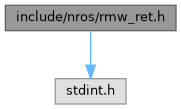
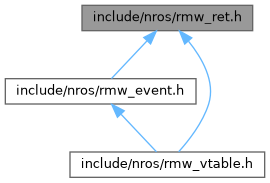
Go to the source code of this file.
Typedefs | |
| typedef int32_t | rmw_ret_t |
Detailed Description
Return-code constants for the nros RMW C vtable.
Functions in nros_rmw_vtable_t and the public C entry points (nros_rmw_cffi_register_named, …) report status as a signed 32-bit integer. Zero is success; every other value is a POSITIVE named constant below — upstream rmw's number where upstream has one, and one above NROS_RMW_RET_EXTENSION_BASE where it does not.
There is ONE return shape: the status is the return value and the ANSWER is an out-parameter. No slot multiplexes a byte count or a flag with a status, and no caller may test a status by its SIGN — gated by scripts/check-rmw-ret-sign.py. Entity constructors are the same shape: they return rmw_ret_t and write the entity through an out-parameter, so there is no pointer-returning failure convention either.
No thread-local error string is exposed by the RMW layer — that pattern requires thread-local heap storage which embedded targets cannot afford. Backends log diagnostic strings at the failure site via the platform's printk-equivalent.
This block stated the PRE-W3.d contract as current until 2026-09-11 and was wrong four ways at once, which is why it is worth recording rather than simply deleting (phase-428 W12): it promised NEGATIVE error codes, where step B adopted upstream's positive numbering; it described a second "byte count + error" convention, which step A retired by moving every count to an out-parameter; it named three slots that have not existed since W3.b renamed them (try_recv_raw, try_recv_request, try_recv_reply_raw — written WITHOUT code ticks on purpose: a backtick in this header means "this identifier
exists", which is the convention check-rmw-doc-slot-names reads); and it described create_publisher as pointer-returning, which it never was after W5. The correct contract was stated 30 lines below, on rmw_ret_t itself, the whole time. Prose in the SSoT header is not covered by the shape gates, which compare DECLARATIONS and never read what a header says about itself — check-rmw-doc-slot-names now covers the part of that which is mechanical, the slot names.
Macro Definition Documentation
◆ NROS_RMW_RET_AMBIGUOUS_BACKEND
| #define NROS_RMW_RET_AMBIGUOUS_BACKEND (NROS_RMW_RET_EXTENSION_BASE + 9) |
Phase 128.A.3 — more than one backend is linked into this binary and the caller did not select one. Set NROS_RMW=<name> (env var) to disambiguate, or use the bridge Executor::open_multi API to bind nodes to backends explicitly.
◆ NROS_RMW_RET_BAD_ALLOC
| #define NROS_RMW_RET_BAD_ALLOC 10 /* upstream RMW_RET_BAD_ALLOC */ |
Memory allocation failed.
Returned by backends on std / alloc-equipped platforms when heap allocation fails. Bare-metal backends generally do not return this — they preallocate at session-open time.
◆ NROS_RMW_RET_BUFFER_TOO_SMALL
| #define NROS_RMW_RET_BUFFER_TOO_SMALL (NROS_RMW_RET_EXTENSION_BASE + 5) |
Buffer supplied by the caller is smaller than the data the backend wants to deliver. From a take, take_request or take_response, the span's len carries the size the payload needed (NROS_RMW_TAKE_LEN_UNKNOWN when the backend cannot know it) — issues 1612 and 1632, rmw_entity.h.
◆ NROS_RMW_RET_CONNECTION_FAILED
| #define NROS_RMW_RET_CONNECTION_FAILED (NROS_RMW_RET_EXTENSION_BASE + 11) |
Phase 155.B.3 — backend reached the wire but couldn't establish a session: refused TCP connect, unreachable agent, peer dropped the link mid-handshake. Distinct from NROS_RMW_RET_ERROR so callers (and the C-side rclc_support_init / nros_cpp_init log lines) can distinguish "I can't reach the router" from "internal
backend invariant tripped". Maps to / from TransportError::ConnectionFailed and Disconnected.
◆ NROS_RMW_RET_ERROR
| #define NROS_RMW_RET_ERROR 1 /* upstream RMW_RET_ERROR */ |
Generic failure not covered by a more specific code.
◆ NROS_RMW_RET_EXTENSION_BASE
| #define NROS_RMW_RET_EXTENSION_BASE 1000 |
First value in the nano-ros extension range. Everything at or above this is ours; everything below it is upstream's or reserved for upstream.
◆ NROS_RMW_RET_INCOMPATIBLE_ABI
| #define NROS_RMW_RET_INCOMPATIBLE_ABI (NROS_RMW_RET_EXTENSION_BASE + 7) |
Phase 115.A.2 — caller-supplied versioned struct (e.g. nros_transport_ops_t) carries an abi_version the runtime does not understand. The previously installed copy (if any) is left untouched.
◆ NROS_RMW_RET_INCOMPATIBLE_QOS
| #define NROS_RMW_RET_INCOMPATIBLE_QOS (NROS_RMW_RET_EXTENSION_BASE + 0) |
Publisher and subscription QoS profiles do not match in a way the backend cannot reconcile (e.g., reliable publisher vs. best-effort subscription on a backend that requires strict matching).
◆ NROS_RMW_RET_INCORRECT_RMW_IMPLEMENTATION
| #define NROS_RMW_RET_INCORRECT_RMW_IMPLEMENTATION 12 /* upstream, unreachable here */ |
Upstream RMW_RET_INCORRECT_RMW_IMPLEMENTATION. Defined for value parity even though a nano-ros image cannot raise it: upstream's rmw returns it when a handle's implementation_identifier does not match the loaded middleware, and an image links exactly one backend. Defined rather than omitted so the value can never be reused for something of ours — the whole point of pinning to upstream's numbering.
◆ NROS_RMW_RET_INVALID_ARGUMENT
| #define NROS_RMW_RET_INVALID_ARGUMENT 11 /* upstream RMW_RET_INVALID_ARGUMENT */ |
Caller supplied a NULL pointer, an out-of-range value, or an inconsistent argument combination.
◆ NROS_RMW_RET_INVALID_CONFIG
| #define NROS_RMW_RET_INVALID_CONFIG (NROS_RMW_RET_EXTENSION_BASE + 12) |
Issue 0468 — a COMPILE-TIME capacity or configuration made the call impossible: the zenoh session pool (ZPICO_MAX_SESSIONS) or a publisher/queryable table is sized smaller than what the application asked for. Distinct from NROS_RMW_RET_INVALID_ARGUMENT, which means the CALLER passed something wrong — here the arguments are fine and the BUILD cannot honour them, so the remedy is a rebuild (or not asking for the extra resource), never a different argument.
Added because TransportError::InvalidConfig had no code of its own and encoded to INVALID_ARGUMENT, so an exhausted session pool arrived on the far side indistinguishable from a bad pointer — the last hop of the same collision that made issue 0465 read as a connection failure. Maps to / from TransportError::InvalidConfig.
◆ NROS_RMW_RET_LOAN_NOT_SUPPORTED
| #define NROS_RMW_RET_LOAN_NOT_SUPPORTED (NROS_RMW_RET_EXTENSION_BASE + 2) |
The backend does not support loaned messages on this entity, or the loan slot is currently in use. Caller may retry, or fall back to the copying path.
◆ NROS_RMW_RET_MESSAGE_TOO_LARGE
| #define NROS_RMW_RET_MESSAGE_TOO_LARGE (NROS_RMW_RET_EXTENSION_BASE + 6) |
Incoming message exceeded the backend's static capacity.
◆ NROS_RMW_RET_NO_BACKEND
| #define NROS_RMW_RET_NO_BACKEND (NROS_RMW_RET_EXTENSION_BASE + 8) |
Phase 128.A.3 — Executor::open / nros::init could not pick a unique backend because no nros-rmw-* crate (or static lib) is linked into this binary. The walker found zero entries in the .nros_rmw_init section.
◆ NROS_RMW_RET_NO_DATA
| #define NROS_RMW_RET_NO_DATA (NROS_RMW_RET_EXTENSION_BASE + 3) |
No data was available on a non-blocking receive. Distinct from NROS_RMW_RET_TIMEOUT: this fires immediately, not after a bounded wait.
◆ NROS_RMW_RET_NODE_NAME_NON_EXISTENT
| #define NROS_RMW_RET_NODE_NAME_NON_EXISTENT 203 /* upstream RMW_RET_NODE_NAME_NON_EXISTENT */ |
A request referenced a node that does not exist in this session.
◆ NROS_RMW_RET_OK
| #define NROS_RMW_RET_OK 0 |
Operation completed successfully.
◆ NROS_RMW_RET_TIMEOUT
| #define NROS_RMW_RET_TIMEOUT 2 /* upstream RMW_RET_TIMEOUT */ |
Operation deadline elapsed before completion.
◆ NROS_RMW_RET_TOPIC_NAME_INVALID
| #define NROS_RMW_RET_TOPIC_NAME_INVALID (NROS_RMW_RET_EXTENSION_BASE + 1) |
Topic, service, or action name failed validation (empty, non-printable bytes, illegal characters).
◆ NROS_RMW_RET_UNKNOWN_BACKEND
| #define NROS_RMW_RET_UNKNOWN_BACKEND (NROS_RMW_RET_EXTENSION_BASE + 10) |
Phase 128.A.3 — caller selected a backend by name (env var or Executor::open_multi) but no registered slot matches. The error is recoverable by linking the requested backend or correcting the spelling.
◆ NROS_RMW_RET_UNSUPPORTED
| #define NROS_RMW_RET_UNSUPPORTED 3 /* upstream RMW_RET_UNSUPPORTED */ |
The backend does not implement this operation. Optional callbacks return this; the runtime then falls back to a default path.
◆ NROS_RMW_RET_WOULD_BLOCK
| #define NROS_RMW_RET_WOULD_BLOCK (NROS_RMW_RET_EXTENSION_BASE + 4) |
Resource (slot, queue, transport buffer) is momentarily unavailable. Caller should retry; never blocks.
Typedef Documentation
◆ rmw_ret_t
| typedef int32_t rmw_ret_t |
Status code. Zero on success.
Phase 376 W3.d step B — the VALUES are upstream rmw's. RMW_RET_OK was already 0 on both sides; everything else moved from a negative code to upstream's positive one, so a status means the same number on both sides of the seam: OK 0, ERROR 1, TIMEOUT 2, UNSUPPORTED 3, BAD_ALLOC 10, INVALID_ARGUMENT 11, INCORRECT_RMW_IMPLEMENTATION 12, NODE_NAME_NON_EXISTENT 203.
(Written as prose, not an indented block: bindgen copies this comment into generated.rs verbatim, and rustdoc reads an indented block there as a Rust DOCTEST — which then fails to compile. Caught by cargo test.)
This is why step A had to come first. Eleven slots used to return a COUNT or a FLAG as a non-negative value and a status as a negative one; with ERROR at 1, a return of 1 would have meant both "one message" and "failed". Every one of those slots now reports through an out-parameter, so the sign carries nothing and the numbers are free to move.
Codes upstream does not define live in the EXTENSION RANGE at 1000+, so a future upstream addition can never collide with one of ours. That range is the one place we knowingly add to upstream's namespace.
Signedness is kept (int32_t, not an unsigned type) to match upstream's rmw_ret_t exactly. Nothing returns a negative value any more.