#include <node.hpp>
Public Member Functions | |
| template<class C, void(C::*)() Method> | |
| Result | create_timer_in_group (const ::rclcpp::CallbackGroup &group, Timer &out, uint64_t period_ms, C *self) |
| Result | create_timer_in_group (const ::rclcpp::CallbackGroup &group, Timer &out, uint64_t period_ms, nros_cpp_timer_callback_t callback, void *context=nullptr) |
| template<class C, void(C::*)() Method> | |
| void | create_timer_in_group (const CallbackGroup &group, uint64_t period_ms) |
| void | create_timer_in_group (const CallbackGroup &group, uint64_t period_ms, nros_cpp_timer_callback_t callback, void *context=nullptr) |
| The plain C callback + ctx form, in a group, parked in the pool. | |
| template<typename Cb> | |
| ::rclcpp::TimerHandle | create_wall_timer (::rclcpp::Duration period, Cb cb, const ::rclcpp::CallbackGroup *group=nullptr, bool autostart=true) |
| template<class C, void(C::*)() Method> | |
| Result | create_wall_timer (Timer &out, uint64_t period_ms, C *self) |
| Result | create_wall_timer (Timer &out, uint64_t period_ms, nros_cpp_timer_callback_t callback, void *context=nullptr) |
| template<class C, void(C::*)() Method> | |
| void | create_wall_timer_in (uint64_t period_ms) |
| void | create_wall_timer_in (uint64_t period_ms, nros_cpp_timer_callback_t callback, void *context=nullptr) |
| The plain C callback + ctx escape hatch, parked in the pool. | |
| Node () | |
| Node (::rclcpp::NodeHandle handle, const char *name, const char *ns=nullptr) | |
| Node (const char *name, const ::rclcpp::NodeOptions &options) | |
| Node (const char *name, const char *ns, const ::rclcpp::NodeOptions &options) | |
| Node (const char *name, const char *ns=nullptr) | |
| Node (Node &&other) | |
| Public Member Functions inherited from rclcpp::Node | |
| Result | add_on_set_parameters_callback (OnSetParametersCallbackType callback, void *context, OnSetParametersCallbackToken &out_handle) |
| bool | check_declared_depth (const char *type_name, const char *topic, const ::rclcpp::QoS &qos) |
| bool | check_declared_param (const char *name, int passed_type) |
| bool | check_declared_qos (const char *type_name, const char *topic, const ::rclcpp::QoS &qos) |
| Result | count_clients (const char *service_name, size_t *out_count) const |
| Result | count_publishers (const char *topic_name, size_t *out_count) const |
| Result | count_services (const char *service_name, size_t *out_count) const |
| Result | count_subscribers (const char *topic_name, size_t *out_count) const |
| template<typename A> | |
| Result | create_action_client (::rclcpp_action::Client< A > &out, const char *action_name, const ::rclcpp::QoS &qos=::rclcpp::QoS::services()) |
| template<typename A> | |
| Result | create_action_server (::rclcpp_action::Server< A > &out, const char *action_name, const ::rclcpp::QoS &qos=::rclcpp::QoS::services(), const ::rclcpp::ActionServerOptions &options={}) |
| ::rclcpp::CallbackGroup::SharedPtr | create_callback_group (::rclcpp::CallbackGroupType type, bool automatically_add_to_executor_with_node=true) |
| ::rclcpp::CallbackGroup | create_callback_group (const char *name) |
| template<typename S, typename F, typename = typename std::enable_if< std::is_convertible<F, void (*)(const typename S::Response&)>::value>::type> | |
| Result | create_client (::rclcpp::Client< S > &out, const char *service_name, F callback, const ::rclcpp::QoS &qos=::rclcpp::QoS::services(), const ::rclcpp::ClientOptions &options={}) |
| template<typename S> | |
| Result | create_client (::rclcpp::PollClient< S > &out, const char *service_name, const ::rclcpp::QoS &qos=::rclcpp::QoS::services()) |
| template<typename S, typename F, typename> | |
| Result | create_client (Client< S > &out, const char *service_name, F callback, const ::rclcpp::QoS &qos, const ::rclcpp::ClientOptions &options) |
| template<typename S, typename F, typename, typename> | |
| Client< S >::SharedPtr | create_client (const char *, F, const ::rclcpp::QoS &) |
| template<typename S, typename F, typename = typename ::rclcpp::tr::enable_if< !::rclcpp::detail::is_qos_arg<F>::value && !::rclcpp::tr::is_convertible<F, void (*)(const typename S::Response&)>::value>::type, typename = void> | |
| typename::rclcpp::Client< S >::SharedPtr | create_client (const char *, F, const ::rclcpp::QoS &=::rclcpp::QoS::services()) |
| REFUSED — upstream's shared_ptr handler shape. | |
| template<typename S> | |
| inline ::rclcpp::Owned<::rclcpp::PollClient< S > > | create_client (const char *name, const ::rclcpp::QoS &qos) |
| template<typename S> | |
| ::rclcpp::Owned<::rclcpp::PollClient< S > > | create_client (const char *name, const ::rclcpp::QoS &qos=::rclcpp::QoS::services()) |
| template<typename S, typename F, typename> | |
| Client< S >::SharedPtr | create_client (const char *name, F callback, const ::rclcpp::QoS &qos) |
| template<typename S, typename F, typename = typename ::rclcpp::tr::enable_if<::rclcpp::tr::is_convertible< F, void (*)(const typename S::Response&)>::value>::type> | |
| typename::rclcpp::Client< S >::SharedPtr | create_client (const char *name, F callback, const ::rclcpp::QoS &qos=::rclcpp::QoS::services()) |
| Callback-style service client (void(const S::Response&)). | |
| template<typename A, typename B, typename... R> | |
| void | create_generic_publisher (const A &topic, const B &type, const ::rclcpp::QoS &qos, const R &...) |
| ::rclcpp::Owned<::rclcpp::GenericPublisher > | create_generic_publisher (const char *topic, const char *type, const char *type_hash, const ::rclcpp::QoS &qos=::rclcpp::QoS::default_profile()) |
| template<typename A, typename B, typename Cb, typename... R> | |
| void | create_generic_subscription (const A &topic, const B &type, const ::rclcpp::QoS &qos, Cb &&callback, const R &...) |
| template<typename Cb> | |
| ::rclcpp::SubscriptionHandle<::rclcpp::GenericSubscription > | create_generic_subscription (const char *topic, const char *type, const char *type_hash, const ::rclcpp::QoS &qos, Cb callback) |
| template<typename Cb> | |
| inline ::rclcpp::SubscriptionHandle<::rclcpp::GenericSubscription > | create_generic_subscription (const char *topic, const char *type, const char *type_hash, const ::rclcpp::QoS &qos, Cb callback) |
| Result | create_guard_condition (::rclcpp::GuardCondition &out, nros_cpp_guard_callback_t callback, void *context=nullptr) |
| template<typename A> | |
| Result | create_polling_action_client (::rclcpp::PollingActionClient< A > &out, const char *action_name) |
| Phase 122.3.d.b — Create an L1 polling-mode action client. | |
| template<typename A> | |
| Result | create_polling_action_server (::rclcpp::PollingActionServer< A > &out, const char *action_name) |
| template<typename M> | |
| Result | create_polling_subscription (::rclcpp::PollingSubscription< M > &out, const char *topic, const ::rclcpp::QoS &qos=::rclcpp::QoS::default_profile()) |
| template<typename M> | |
| Result | create_publisher (::rclcpp::Publisher< M > &out, const char *topic, const ::rclcpp::QoS &qos, const ::rclcpp::PublisherOptions &options) |
| template<typename M> | |
| Result | create_publisher (::rclcpp::Publisher< M > &out, const char *topic, const ::rclcpp::QoS &qos=::rclcpp::QoS::default_profile()) |
| template<typename M> | |
| typename::rclcpp::Publisher< M >::SharedPtr | create_publisher (const char *topic, ::size_t depth) |
| create_publisher<M>(topic, depth) — the integer-depth spelling. | |
| template<typename M> | |
| Publisher< M >::SharedPtr | create_publisher (const char *topic, ::size_t depth) |
| template<typename M> | |
| Publisher< M >::SharedPtr | create_publisher (const char *topic, const ::rclcpp::QoS &qos) |
| template<typename M> | |
| typename::rclcpp::Publisher< M >::SharedPtr | create_publisher (const char *topic, const ::rclcpp::QoS &qos=::rclcpp::QoS::default_profile()) |
| create_publisher<M>(topic, qos) — available on every target. | |
| template<typename M> | |
| Result | create_publisher (Publisher< M > &out, const char *topic, const ::rclcpp::QoS &qos) |
| template<typename M> | |
| Result | create_publisher (Publisher< M > &out, const char *topic, const ::rclcpp::QoS &qos, const ::rclcpp::PublisherOptions &options) |
| template<typename M> | |
| ::rclcpp::Publisher< M > | create_publisher_in (const char *topic, const ::rclcpp::QoS &qos=::rclcpp::QoS::default_profile()) |
| template<typename M> | |
| Result | create_publisher_in_group (const ::rclcpp::CallbackGroup &, ::rclcpp::Publisher< M > &out, const char *topic, const ::rclcpp::QoS &qos=::rclcpp::QoS::default_profile()) |
| template<typename S> | |
| Result | create_service (::rclcpp::PollService< S > &out, const char *service_name, const ::rclcpp::QoS &qos=::rclcpp::QoS::services()) |
| template<typename S, typename F, typename = typename std::enable_if<std::is_convertible< F, void (*)(const typename S::Request&, typename S::Response&)>::value>::type> | |
| Result | create_service (::rclcpp::Service< S > &out, const char *service_name, F callback, const ::rclcpp::QoS &qos=::rclcpp::QoS::services(), const ::rclcpp::ServiceOptions &options={}) |
| template<typename S, typename F, typename = typename ::rclcpp::tr::enable_if< !::rclcpp::detail::is_qos_arg<F>::value && !::rclcpp::tr::is_convertible<F, void (*)(const typename S::Request&, typename S::Response&)>::value>::type, typename = void> | |
| typename::rclcpp::Service< S >::SharedPtr | create_service (const char *, F, const ::rclcpp::QoS &=::rclcpp::QoS::services()) |
| template<typename S> | |
| inline ::rclcpp::Owned<::rclcpp::PollService< S > > | create_service (const char *name, const ::rclcpp::QoS &qos) |
| template<typename S> | |
| ::rclcpp::Owned<::rclcpp::PollService< S > > | create_service (const char *name, const ::rclcpp::QoS &qos=::rclcpp::QoS::services()) |
| template<typename S, typename F, typename, typename> | |
| Service< S >::SharedPtr | create_service (const char *name, F callback, const ::rclcpp::QoS &qos) |
| template<typename S, typename F, typename> | |
| Service< S >::SharedPtr | create_service (const char *name, F callback, const ::rclcpp::QoS &qos) |
| template<typename S, typename F> | |
| typename::rclcpp::Service< S >::SharedPtr | create_service (const char *name, F callback, const ::rclcpp::QoS &qos, const ::rclcpp::CallbackGroup *group) |
| template<typename S, typename F> | |
| Service< S >::SharedPtr | create_service (const char *name, F callback, const ::rclcpp::QoS &qos, const ::rclcpp::CallbackGroup *group) |
| template<typename S, typename F, typename = typename ::rclcpp::tr::enable_if<::rclcpp::tr::is_convertible< F, void (*)(const typename S::Request&, typename S::Response&)>::value>::type> | |
| typename::rclcpp::Service< S >::SharedPtr | create_service (const char *name, F callback, const ::rclcpp::QoS &qos=::rclcpp::QoS::services()) |
| Callback-style service server (void(const S::Request&, S::Response&)). | |
| template<typename S, typename F, typename> | |
| Result | create_service (Service< S > &out, const char *service_name, F callback, const ::rclcpp::QoS &qos, const ::rclcpp::ServiceOptions &options) |
| template<typename M> | |
| Result | create_subscription (::rclcpp::PollSubscription< M > &out, const char *topic, const ::rclcpp::QoS &qos, const ::rclcpp::SubscriptionOptions &options) |
| template<typename M> | |
| Result | create_subscription (::rclcpp::PollSubscription< M > &out, const char *topic, const ::rclcpp::QoS &qos=::rclcpp::QoS::default_profile()) |
| template<typename M, typename F, typename = typename std::enable_if<std::is_convertible<F, void (*)(const M&)>::value>::type> | |
| Result | create_subscription (::rclcpp::Subscription< M > &out, const char *topic, const ::rclcpp::QoS &qos, F callback, const ::rclcpp::SubscriptionOptions &options={}) |
| template<typename M, typename Cb> | |
| typename::rclcpp::Subscription< M >::SharedPtr | create_subscription (const char *topic, ::size_t depth, Cb cb) |
| create_subscription<M>(topic, depth, callback). | |
| template<typename M, typename Cb> | |
| Subscription< M >::SharedPtr | create_subscription (const char *topic, ::size_t depth, Cb cb) |
| template<typename M, typename Cb> | |
| typename::rclcpp::Subscription< M >::SharedPtr | create_subscription (const char *topic, ::size_t depth, Cb cb, const ::rclcpp::SubscriptionOptions &options) |
| create_subscription<M>(topic, depth, callback, options). | |
| template<typename M, typename Cb> | |
| Subscription< M >::SharedPtr | create_subscription (const char *topic, ::size_t depth, Cb cb, const ::rclcpp::SubscriptionOptions &options) |
| template<typename M, typename Cb> | |
| typename::rclcpp::Subscription< M >::SharedPtr | create_subscription (const char *topic, const ::rclcpp::QoS &qos, Cb cb) |
| template<typename M, typename Cb> | |
| Subscription< M >::SharedPtr | create_subscription (const char *topic, const ::rclcpp::QoS &qos, Cb cb) |
| template<typename M, typename Cb> | |
| typename::rclcpp::Subscription< M >::SharedPtr | create_subscription (const char *topic, const ::rclcpp::QoS &qos, Cb cb, const ::rclcpp::SubscriptionOptions &options) |
| template<typename M, typename Cb> | |
| Subscription< M >::SharedPtr | create_subscription (const char *topic, const ::rclcpp::QoS &qos, Cb cb, const ::rclcpp::SubscriptionOptions &options) |
| template<typename M, typename F, typename> | |
| Result | create_subscription (Subscription< M > &out, const char *topic, const ::rclcpp::QoS &qos, F callback, const ::rclcpp::SubscriptionOptions &options) |
| template<typename M, class C, void(C::*)(const M &msg) Method> | |
| void | create_subscription_in (const char *topic, const ::rclcpp::QoS &qos=::rclcpp::QoS::default_profile()) |
| template<typename M, typename F, typename = typename std::enable_if<std::is_convertible<F, void (*)(const M&)>::value>::type> | |
| Result | create_subscription_in_group (const ::rclcpp::CallbackGroup &group, ::rclcpp::Subscription< M > &out, const char *topic, const ::rclcpp::QoS &qos, F callback, const ::rclcpp::SubscriptionOptions &options={}) |
| template<typename M, class C, void(C::*)(const M &msg) Method> | |
| void | create_subscription_in_group (const ::rclcpp::CallbackGroup &group, const char *topic, const ::rclcpp::QoS &qos=::rclcpp::QoS::default_profile()) |
| template<typename M, typename F, typename> | |
| Result | create_subscription_in_group (const ::rclcpp::CallbackGroup &group, Subscription< M > &out, const char *topic, const ::rclcpp::QoS &qos, F callback, const ::rclcpp::SubscriptionOptions &options) |
| template<typename M, typename F, typename = typename std::enable_if< std::is_convertible<F, void (*)(const M&, const uint8_t*, size_t)>::value>::type> | |
| Result | create_subscription_with_info (::rclcpp::Subscription< M > &out, const char *topic, const ::rclcpp::QoS &qos, F callback, const ::rclcpp::SubscriptionOptions &options={}) |
| template<typename M, typename F, typename> | |
| Result | create_subscription_with_info (Subscription< M > &out, const char *topic, const ::rclcpp::QoS &qos, F callback, const ::rclcpp::SubscriptionOptions &options) |
| template<class C, void(C::*)() Method> | |
| Result | create_timer (Timer &out, const Clock &clock, uint64_t period_ms, C *self) |
| Result | create_timer (Timer &out, const Clock &clock, uint64_t period_ms, nros_cpp_timer_callback_t callback, void *context=nullptr) |
| template<class C, void(C::*)() Method> | |
| Result | create_timer_in_group (const ::rclcpp::CallbackGroup &group, Timer &out, uint64_t period_ms, C *self) |
| Result | create_timer_in_group (const ::rclcpp::CallbackGroup &group, Timer &out, uint64_t period_ms, nros_cpp_timer_callback_t callback, void *context=nullptr) |
| Result | create_timer_oneshot (Timer &out, uint64_t delay_ms, nros_cpp_timer_callback_t callback, void *context=nullptr) |
| template<typename Cb> | |
| inline ::rclcpp::TimerHandle | create_wall_timer (::rclcpp::Duration period, Cb cb, const ::rclcpp::CallbackGroup *group, bool autostart) |
| template<typename Cb> | |
| ::rclcpp::TimerHandle | create_wall_timer (::rclcpp::Duration period, Cb cb, const ::rclcpp::CallbackGroup *group=nullptr, bool autostart=true) |
| template<class C, void(C::*)() Method> | |
| Result | create_wall_timer (Timer &out, uint64_t period_ms, C *self) |
| Result | create_wall_timer (Timer &out, uint64_t period_ms, nros_cpp_timer_callback_t callback, void *context=nullptr) |
| template<typename T> | |
| T | declare_parameter (const char *name, T default_value, const ParameterDescriptor &descriptor) |
| template<typename T> | |
| T | declare_parameter (const char *name, T default_value=T()) |
| rclcpp::Node::declare_parameter<T>(name, default). | |
| Result | describe_parameter (const char *name, ParameterDescriptor &out, char *text, ::size_t text_len) const |
| int32_t | error_code () const |
| The raw error code of the first latched failure, or 0. | |
| const char * | error_what () const |
| void * | executor_handle () const |
| const nros_cpp_node_t * | ffi_handle () const |
| template<typename S> | |
| Result | finish_register_service_ (Service< S > &out, const char *service_name, nros_cpp_ret_t ret, size_t handle) |
| Result | get_client_names_and_types_by_node (const char *node_name, const char *node_namespace, nros_cpp_names_and_types_visit_fn visit, void *ctx) const |
| Clock * | get_clock () |
| const Clock * | get_clock () const |
| Const overload of get_clock(). | |
| Result | get_fully_qualified_name (char *buf, size_t buf_len, size_t *out_len=nullptr) const |
| ::rclcpp::Logger | get_logger () const |
| const char * | get_name () const |
| Get the node name. | |
| const char * | get_namespace () const |
| Get the node namespace. | |
| ::rclcpp::node_interfaces::NodeBaseInterface::SharedPtr | get_node_base_interface () |
| ::rclcpp::node_interfaces::NodeClockInterface::SharedPtr | get_node_clock_interface () |
| See get_node_base_interface. | |
| ::rclcpp::node_interfaces::NodeGraphInterface::SharedPtr | get_node_graph_interface () |
| See get_node_base_interface. | |
| ::rclcpp::node_interfaces::NodeLoggingInterface::SharedPtr | get_node_logging_interface () |
| See get_node_base_interface. | |
| Result | get_node_names (nros_cpp_node_visit_fn visit, void *ctx) const |
| const ::rclcpp::NodeOptions & | get_node_options () const |
| ::rclcpp::node_interfaces::NodeWaitablesInterface::SharedPtr | get_node_waitables_interface () |
| See get_node_base_interface. | |
| template<typename T> | |
| T | get_parameter (const char *name) const |
| Value-returning read; T() when the name is undeclared. | |
| template<typename T> | |
| bool | get_parameter (const char *name, T &out) const |
| template<typename T> | |
| bool | get_parameter_or (const char *name, T &out, T fallback) const |
| ParameterType | get_parameter_type (const char *name) const |
| Result | get_parameter_types (const char *const *names, ::size_t count, ParameterType *out) const |
| Result | get_publisher_names_and_types_by_node (const char *node_name, const char *node_namespace, nros_cpp_names_and_types_visit_fn visit, void *ctx) const |
| Result | get_publishers_info_by_topic (const char *topic_name, ::rclcpp::TopicEndpointInfoVisitFn visit, void *ctx) const |
| Result | get_publishers_info_by_topic (const char *topic_name, nros_cpp_endpoint_info_visit_fn visit, void *ctx) const |
| Result | get_service_names_and_types (nros_cpp_names_and_types_visit_fn visit, void *ctx) const |
| Result | get_service_names_and_types_by_node (const char *node_name, const char *node_namespace, nros_cpp_names_and_types_visit_fn visit, void *ctx) const |
| Result | get_subscription_names_and_types_by_node (const char *node_name, const char *node_namespace, nros_cpp_names_and_types_visit_fn visit, void *ctx) const |
| Result | get_subscriptions_info_by_topic (const char *topic_name, ::rclcpp::TopicEndpointInfoVisitFn visit, void *ctx) const |
| Result | get_subscriptions_info_by_topic (const char *topic_name, nros_cpp_endpoint_info_visit_fn visit, void *ctx) const |
| Result | get_topic_names_and_types (nros_cpp_names_and_types_visit_fn visit, void *ctx) const |
| bool | has_parameter (const char *name) const |
| rclcpp::Node::has_parameter(name). | |
| Result | init (const char *name, const char *ns=nullptr) |
| Result | init_on (void *executor_handle, const char *name, const char *ns=nullptr) |
| bool | initialized () const |
| bool | is_valid () const |
| Check if the node is initialized and valid. | |
| Result | list_parameters (const char *prefix, char *out_names, ::size_t name_stride, ::size_t max_names, ::size_t &count) const |
| Node () | |
| Node (::rclcpp::NodeHandle handle, const char *name, const char *ns=nullptr) | |
| Node (const char *name, const ::rclcpp::NodeOptions &options) | |
| Node (const char *name, const char *ns, const ::rclcpp::NodeOptions &options) | |
| Node (const char *name, const char *ns=nullptr) | |
| Node (Node &&other) | |
| Time | now () const |
| Node & | nros_node () |
| const Node & | nros_node () const |
| Const overload of [nros_node]. | |
| bool | ok () const |
| Node & | operator= (Node &&other) |
| template<typename S> | |
| Result | register_service_ (Service< S > &out, const char *service_name, bool(*trampoline)(const uint8_t *, size_t, uint8_t *, size_t, size_t *, void *), void *context, const ::rclcpp::QoS &qos, const ::rclcpp::ServiceOptions &options, const void *capture, size_t capture_len, void(*capture_drop)(void *)) |
| template<typename S> | |
| Result | register_service_ (Service< S > &out, const char *service_name, nros_cpp_service_request_id_callback_t trampoline, void *context, const ::rclcpp::QoS &qos, const ::rclcpp::ServiceOptions &options, const void *capture, size_t capture_len, void(*capture_drop)(void *)) |
| Result | remove_on_set_parameters_callback (OnSetParametersCallbackToken handle) |
| rclcpp::Node::remove_on_set_parameters_callback(handle). | |
| const char * | rmw_implementation_identifier () const |
| const char * | serialization_format () const |
| void | set_error (const char *what, int32_t code) |
| template<typename T> | |
| Result | set_parameter (const char *name, T value) |
| Result | set_parameters_atomically (const ParameterWrite *writes, ::size_t count) |
| void | set_qos_overrides (const nros_cpp_qos_override_t *overrides, size_t len) |
| SharedPtr | shared_from_this () |
| ConstSharedPtr | shared_from_this () const |
| Const overload of [shared_from_this]. | |
| Result | start_parameter_services () |
| Result | undeclare_parameter (const char *name) |
| ~Node () | |
Additional Inherited Members | |
| Public Types inherited from rclcpp::Node | |
| using | ConstSharedPtr = ::rclcpp::Handle<const Node> |
| rclcpp::Node::ConstSharedPtr. | |
| using | ConstWeakPtr = ::rclcpp::Handle<const Node> |
| Const spelling of WeakPtr. | |
| using | SharedPtr = ::rclcpp::Handle<Node> |
| using | WeakPtr = ::rclcpp::Handle<Node> |
| Static Public Member Functions inherited from rclcpp::Node | |
| static Result | create (Node &out, const char *name, const char *ns=nullptr) |
Detailed Description
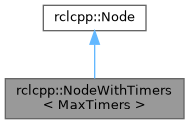
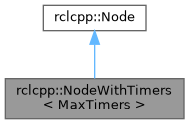
class rclcpp::NodeWithTimers< MaxTimers >
Issue 1131 — the pool is a fixed inline C array, and zero is not a smaller one: Timer timers_[0] is not ISO C++ (GCC/Clang accept it only as the zero-length-array extension). A node that owns no timer does not derive this template at all, which is the real zero.
Below the #ifndef, never above it: an undefined identifier reads as 0 in #if, so a guard above its own default fires on every build (issue 1167). A Node plus an inline pool of MaxTimers rclcpp::Timer slots.
rclcpp::Timer's destructor cancels its timer, so a timer created in a constructor must outlive the call. The out-ref create_wall_timer(Timer&, …) / create_timer_in_group(group, Timer&, …) family on Node makes that the caller's problem, which is the right default. This template is for the component shape, where the storage-free spelling is the ergonomic one:
Member Function Documentation
◆ create_timer_in_group() [1/4]
|
inline |
Bind a member void C::on_tick() as a timer IN a callback group (RFC-0047) — the member-binding half of create_timer_in_group.
◆ create_timer_in_group() [2/4]
|
inline |
Create a repeating timer in a callback group (RFC-0047).
Like create_wall_timer but associates the timer with group so the executor binds it to the group's SchedContext via group_sched_table. group.get_name() == nullptr or empty falls back to node default.
- Parameters
-
group Callback group (from create_callback_group). out Receives the initialized timer. period_ms Timer period in milliseconds. callback C function pointer invoked on each tick. context User context passed to the callback (may be nullptr).
◆ create_timer_in_group() [3/4]
|
inline |
A typed member repeating timer in a callback group (RFC-0047), parked in the pool. Was ComponentNode::create_timer_in<C, Method>.
◆ create_timer_in_group() [4/4]
|
inline |
The plain C callback + ctx form, in a group, parked in the pool.
◆ create_wall_timer() [1/3]
| ::rclcpp::TimerHandle rclcpp::Node::create_wall_timer | ( | ::rclcpp::Duration | period, |
| Cb | cb, | ||
| const ::rclcpp::CallbackGroup * | group = nullptr, | ||
| bool | autostart = true ) |
create_wall_timer(period, callback) — upstream's shape, FREESTANDING.
phase-476 W2. Takes any callable (a capturing lambda, a std::bind result) and returns a two-word [rclcpp::TimerHandle]; the callable is copied into the executor arena, which destroys it when the timer is released, so nothing here allocates and nothing needs <memory> or <functional>. The node owns the timer: destroying the node releases it. Body in nros.hpp.
ADOPT-BOUNDED as before: the period is truncated to whole milliseconds, and a missed deadline catches up where rcl drops (see rclcpp::Timer).
Issue 1974 — Jazzy's (period, callback, group = nullptr, autostart = true). group is a const rclcpp::CallbackGroup* (our group is a value token, so a ported nullptr binds and &group names one); autostart = false creates the timer cancelled until reset(). A callback invocable as void(const rclcpp::TimerInfo&) receives the activation's expected and actual call times.
◆ create_wall_timer() [2/3]
|
inline |
Bind a member void C::on_tick() as a wall-timer callback.
◆ create_wall_timer() [3/3]
|
inline |
Create a repeating WALL timer — rclcpp::Node::create_wall_timer.
The callback fires during spin_once() at the specified period, measured on the platform's monotonic clock. For a timer that follows simulated time, see create_timer above.
- Parameters
-
out Receives the initialized timer. period_ms Timer period in milliseconds. callback C function pointer invoked on each tick. context User context passed to the callback (may be nullptr).
◆ create_wall_timer_in() [1/2]
|
inline |
Create a typed member repeating wall timer parked in the pool.
Was ComponentNode::create_wall_timer<C, Method>(period_ms); _in because upstream's create_wall_timer(duration, callback) is a different shape on the same type and a signature-only difference is resolved silently. Latches ok()=false on failure or pool exhaustion.
◆ create_wall_timer_in() [2/2]
|
inline |
The plain C callback + ctx escape hatch, parked in the pool.
◆ Node() [1/6]
|
inline |
Default constructor — creates an uninitialized node. Pair with [init].
◆ Node() [2/6]
|
inlineexplicit |
Construct against an EXPLICIT executor-bound handle — what a generated entry writes, and what nros::ComponentNode(NodeHandle, name) was before phase-427 W4 merged it here.
This is the SECOND of the type's two constructors. On a null handle or a creation failure it latches the error rather than aborting: the entry checks ok() post-construct and halts naming this node (RFC-0044 Q2).
Precedence (issue 1456), per HALF of the identity and stated rather than emergent:
launch-declared (on the handle) > this constructor's argument > the type's own default (name is required; ns defaults to UNSET, which since issue 1473 means the EXECUTOR's namespace, not the root)
So a component whose class hardcodes a DIFFERENT name than the launch file declares is named by the LAUNCH FILE, which is the only answer that lets one component class be instantiated twice in one launch file: two Comp(h) : Node(h, "talker") objects would otherwise both be /talker. It is upstream's order too — -r __node:=alpha outranks the literal an rclcpp::Node subclass passes its base.
The halves are independent: a launch file declaring only a namespace leaves the class's name standing (/island/talker), and one declaring neither changes nothing at all. The class's literal is a DEFAULT, never dead — which is what keeps a hand-written main constructing the same component (no entry, no handle identity) working unchanged.
◆ Node() [3/6]
|
inline |
Upstream's (name, options) constructor, freestanding. The one option NodeOptions carries, clock_type() (issue 1975), picks the node's clock; every other option refuses at its call site (options.hpp).
◆ Node() [4/6]
|
inline |
Upstream's (name, namespace, options) constructor, freestanding. No default for options here: Node(name, ns) is the two-argument constructor above, and a default would make that call ambiguous.
◆ Node() [5/6]
|
inlineexplicit |
rclcpp::Node("talker") — upstream's shape, no allocator, every target.
Opens on the GLOBAL executor rclcpp::init() created (issue 0465 — one session per image). ADOPT-BOUNDED: upstream throws where this leaves ok() false, which is weaker, so it has to be LOUD by other means — the generated entry checks ok() and halts naming the node (RFC-0044 Q2), and a hand-written main must check it. The book says so; the compiler cannot.
◆ Node() [6/6]
|
inline |
The documentation for this class was generated from the following file:
- include/rclcpp/node.hpp
