Service server API. More...
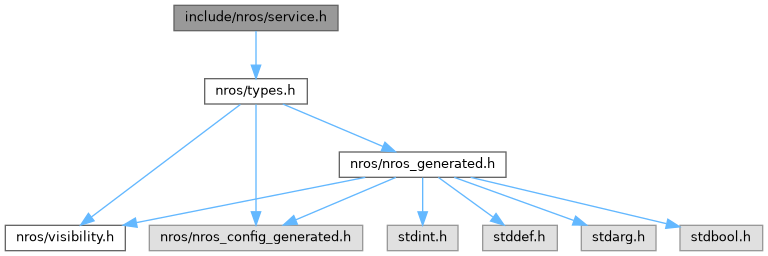
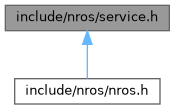
Go to the source code of this file.
Functions | |
| static struct rclc_qos_t | rclc_qos_services_best_effort (void) |
The QoS rclc's service/client _best_effort presets actually use. | |
| static rcl_ret_t | rclc_service_init_best_effort (struct rcl_service_t *service, const struct rcl_node_t *node, const struct rclc_service_type_t *type_info, const char *service_name) |
| rclc's best-effort preset constructor for a service server. | |
Detailed Description
Service server API.
Create a service server with rclc_service_init_default() (or rclc_service_init_with_qos()) and add it to an executor with rclc_executor_add_service_raw(), which takes the rclc_service_raw_callback_t. The executor arena owns the server and the callback, delivers requests and sends responses for you.
For manual polling with no executor, use the separate type rclc_polling_service_t: create it with rclc_polling_service_init(), take requests with rclc_polling_service_take_request_raw(), and send responses with rclc_polling_service_send_response_raw(). The two types are separate since phase-487: a dispatched server's storage is in the executor arena, a polled one's is in the struct.
For a TYPED handler — a deserialised request in, a typed response out, with no hand-written CDR — the generated per-service header emits <Srv>_service_handler_t, <Srv>_service_handler_init(), <Srv>_service_init() and <Srv>_executor_add_service(); see packs/c/service.h.jinja (phase-417 W5.e). Those are static inline glue over the same entry points documented here, so the two paths cannot diverge.
Function Documentation
◆ rclc_qos_services_best_effort()
|
inlinestatic |
The QoS rclc's service/client _best_effort presets actually use.
phase-417 W5.d. Read from rclc's own source (rclc/src/rclc/service.c and client.c @ 10eadcc): rclc does NOT reach for a named upstream profile here the way the pub/sub presets reach for rmw_qos_profile_sensor_data. It COPIES rmw_qos_profile_services_default and flips one field —
rmw_qos_profile_t p = rmw_qos_profile_services_default;
p.reliability = RMW_QOS_POLICY_RELIABILITY_BEST_EFFORT;
— so the depth stays 10 rather than dropping to the sensor profile's 5. Two call sites need that value, so it is computed in ONE place rather than written out twice (issue 0160's hand-mirror class, at header scale).
RCLC_QOS_SERVICES is our mirror of rmw_qos_profile_services_default, so the copy starts there. The reliable sibling rclc_service_init_default reaches its profile by passing a NULL qos, which resolves to RCLC_QOS_DEFAULT — field-identical to RCLC_QOS_SERVICES today (both RELIABLE / VOLATILE / KEEP_LAST(10)), so the pair differs only in reliability, exactly as rclc's pair does.
Returns by value: a rclc_qos_t is a plain scalar struct, and the caller needs a mutable copy to take the address of. Nothing here is static, so the header adds no writable data.
◆ rclc_service_init_best_effort()
|
inlinestatic |
rclc's best-effort preset constructor for a service server.
phase-417 W5.d; the service-side sibling of rclc_publisher_init_best_effort(), and the same argument. Ledger row c:service_init_best_effort filed a divergence on "ours takes a QoS
value" — true, and not a reason for the name rclc ships to be missing.
Takes no callback, at rclc's arity: the handler is supplied at registration by rclc_executor_add_service_raw(), where rclc supplies it (rclc_executor_add_service). Same split rclc_service_init_default already makes.
static inline: no symbol, no writable data.
- Parameters
-
[out] service Zero-initialised service to fill in. [in] node An initialised node. [in] type_info Generated service type descriptor. [in] service_name Service name, null-terminated.
- Returns
- Whatever rclc_service_init_with_qos() returns.