Periodic timer API. More...
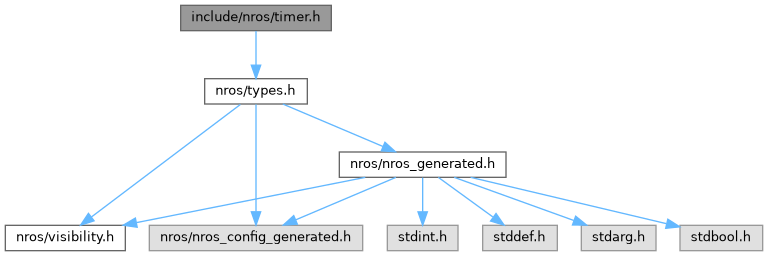
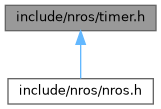
Go to the source code of this file.
Functions | |
| static rcl_ret_t | rcl_difference_times (const struct rclc_time_t *start, const struct rclc_time_t *finish, struct rcl_duration_t *delta) |
Compute the duration between two time points: finish - start. | |
Detailed Description
Periodic timer API.
Create timers with rclc_timer_init_with_context() and register them with an executor via rclc_executor_add_timer().
Function Documentation
◆ rcl_difference_times()
|
inlinestatic |
Compute the duration between two time points: finish - start.
rcl's rcl_difference_times(const rcl_time_point_t *start,
const rcl_time_point_t *finish, rcl_duration_t *delta) — Time - Time -> Duration. Ledger row c:difference_times (phase-379 W5, group B) records why this was a gap rather than a rename: rclc_time_sub is Time - Duration -> Time, a different operation with different operands and a different return type, so there was never a rename to make. C++ ships the operation as Time::operator-(const Time &) -> Duration and Rust as impl Sub<Time> for Time; only C had no way to get a duration out of two timestamps.
A static inline rather than an exported symbol because there is no state behind it: this is arithmetic on two values the caller already holds. Nothing is computed here that is not already an entry point — the decode is rclc_time_to_nanoseconds and the encode is rclc_duration_from_nanoseconds, which is the ONE place the builtin_interfaces {sec, nanosec} split (floor division, non-negative remainder, issue 0799) is implemented. Open-coding the split here is what the C++ Duration::to_msg used to do, and it got negatives wrong.
Overflow, and how this differs from rcl
The nanosecond subtraction cannot overflow. rclc_time_t is {int32_t sec, uint32_t nanosec}, so a decoded time point is bounded by roughly ±2.15e18 ns and any difference of two of them by ±4.3e18 ns — inside int64_t's ±9.22e18. rcl has no such bound: rcl_time_point_t carries a bare int64_t nanosecond count, and rcl_difference_times subtracts two of them with plain signed arithmetic (rcl/src/rcl/time.c, rcl_difference_times), which is undefined behaviour at the extremes of the type. Our narrower time encoding removes the case rather than checking for it.
What can exceed its type is the RESULT once re-encoded: a duration of ±4.3e9 seconds does not fit rcl_duration_t's int32_t sec. rclc_duration_from_nanoseconds SATURATES there — it clamps to the nearest representable duration rather than wrapping, which keeps the encoding monotone (see its own note on split_nanoseconds). It is the only behaviour available to a function with no error channel, and it is the same choice every other _time_ entry point already makes.
Divergence from rcl, deliberate
rcl returns RCL_RET_ERROR when the two points carry different clock_types. Ours cannot: ledger row c:time_point_t records that rclc_time_t is the value alone and the clock kind is a property of the clock it was read from, not of every timestamp — which halves a timestamp on the wire and in a message. Differencing two times read from different clocks is therefore the caller's obligation here, and the header says so rather than the function pretending to check.
- Parameters
-
[in] start The time point for the start of the duration. [in] finish The time point for the end of the duration. [out] delta finish - start. Negative whenfinishprecedesstart, encoded the waybuiltin_interfaces/msg/Durationrequires ({sec: -2, nanosec: 3e8}is -1.7 s).
- Returns
RCL_RET_OK, orRCL_RET_INVALID_ARGUMENTif any argument is NULL.