Canonical C ABI for the nros platform timer surface. More...
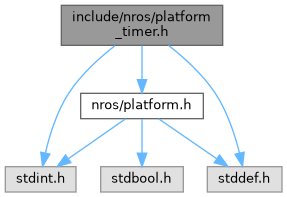
Go to the source code of this file.
Typedefs | |
| typedef void(* | nros_platform_timer_callback_t) (void *user_data) |
Functions | |
| int8_t | nros_platform_timer_cancel (void *handle) |
| void * | nros_platform_timer_create_oneshot (uint32_t timeout_us, nros_platform_timer_callback_t callback, void *user_data) |
| void * | nros_platform_timer_create_periodic (uint32_t period_us, nros_platform_timer_callback_t callback, void *user_data) |
| void | nros_platform_timer_destroy (void *handle) |
Detailed Description
Canonical C ABI for the nros platform timer surface.
Companion to <nros/platform.h>; sits beside the core 39-symbol ABI as the Phase 110.E platform-timer interface. Carved into a separate header because bare-metal / single-shot consumers can omit timer support without losing the canonical platform symbols.
Handle model
Platform timer handles are opaque void *. The implementation allocates whatever it needs to track the underlying primitive (TimerHandle_t on FreeRTOS, TX_TIMER * on ThreadX, timer_t on POSIX, *mut k_timer on Zephyr); the runtime never inspects the bytes pointed at.
Return-value conventions
create_periodic/create_oneshotreturn non-NULL on success andNULLon failure (analogous to libcmalloc).cancelreturns 1 when the cancellation prevented the callback from firing, 0 if the callback already fired (or the timer was already cancelled or destroyed), -1 on unrecoverable error.destroyis best-effort; idempotent on already-destroyed handles.
Threading / context
Callbacks are invoked from a platform-defined timer context — a direct ISR on Zephyr / bare-metal, deferred to the FreeRTOS timer task on FreeRTOS, a real-time signal on POSIX. Callback bodies must be short, must not call back into nros_platform_* heap or blocking primitives, and must use atomic operations for shared state. user_data must outlive the timer handle.
Typedef Documentation
◆ nros_platform_timer_callback_t
| typedef void(* nros_platform_timer_callback_t) (void *user_data) |
Function Documentation
◆ nros_platform_timer_cancel()
| int8_t nros_platform_timer_cancel | ( | void * | handle | ) |
Cancel a previously-armed timer. Returns:
- 1 if cancellation prevented the callback from firing,
- 0 if the callback already fired (or the timer was already cancelled / destroyed),
- -1 on unrecoverable error.
Distinct from destroy — the handle remains valid after cancel and may be re-armed by the application's own bookkeeping if the implementation supports it.
◆ nros_platform_timer_create_oneshot()
| void * nros_platform_timer_create_oneshot | ( | uint32_t | timeout_us, |
| nros_platform_timer_callback_t | callback, | ||
| void * | user_data | ||
| ) |
Register a one-shot timer that invokes callback(user_data) once after timeout_us microseconds. Returns the platform-native handle on success, NULL on failure.
◆ nros_platform_timer_create_periodic()
| void * nros_platform_timer_create_periodic | ( | uint32_t | period_us, |
| nros_platform_timer_callback_t | callback, | ||
| void * | user_data | ||
| ) |
Register a periodic timer that invokes callback(user_data) every period_us microseconds. Returns the platform-native handle on success, NULL on failure.
◆ nros_platform_timer_destroy()
| void nros_platform_timer_destroy | ( | void * | handle | ) |
Cancel + free the timer. Drains in-flight callback invocations before returning so user_data is no longer accessed. Idempotent on already-destroyed handles.