#include <future.hpp>
Public Member Functions | |
| bool | can_send () const |
| size_t | count () const |
| void | deliver (PendingLink *owner, const uint8_t *data, size_t len) |
| Hand a reply to owner, which is answered and leaves the list. | |
| void | link (PendingLink *l) |
| void | move_to (PendingList &to, void *storage) |
| void | orphan_all () |
| size_t | prune () |
| void | relink (PendingLink *from, PendingLink *to) |
| A moved future: the list must point at its new address. | |
| bool | remove_seq (int64_t seq) |
| PendingLink * | resolve (int64_t seq) |
| PendingLink * | resolve_goal (const uint8_t goal[16]) |
| bool | unlink (PendingLink *l, bool abandoned) |
Public Attributes | |
| void(* | forget )(void *ctx, const uint8_t goal[16]) = nullptr |
| void * | forget_ctx = nullptr |
| PendingLink * | head = nullptr |
| uint8_t | orphans = 0 |
Detailed Description
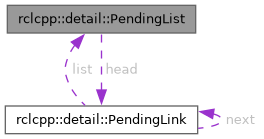
Issue 2009 — the requests ONE poll client has in flight, as an intrusive list of the futures waiting on them, each keyed by its request's sequence id. A reply is delivered only to the future whose id it carries; a reply naming no pending future (a removed or destroyed one's) is dropped.
The same rule as Rust's nros_rmw::RequestCorrelator, which every other client surface uses. It lives in the futures here rather than in a table because each future already owns the buffer its reply must land in.
BOUNDED, NO HEAP, NO CAPACITY TO MIS-SIZE: an entry is a future the caller already holds, so the list is as long as the futures in flight. What caps that is the transport's own outstanding-request limit (zenoh NROS_ZENOH_MAX_PENDING_GETS, Cyclone's 8 per client): a send past it is refused by the backend, and send_request then returns an empty future (valid() false) without linking anything.
A backend that cannot assign ids (SEQUENCE_ID_UNKNOWN) gets one request in flight per client — can_send() refuses a second while the first is pending — and an unkeyed reply goes to the sole pending future. A removed unkeyed request costs the next unkeyed reply (orphans), which is dropped rather than delivered to a newer request it cannot be told apart from.
Member Function Documentation
◆ can_send()
|
inline |
◆ count()
|
inline |
◆ deliver()
|
inline |
Hand a reply to owner, which is answered and leaves the list.
◆ link()
|
inline |
◆ move_to()
|
inline |
The poll client that owns this list MOVED to to (whose storage is storage): every pending future follows it.
◆ orphan_all()
|
inline |
The poll client that owns this list is going away: every pending future becomes invalid (valid() false) instead of pointing at freed storage.
◆ prune()
|
inline |
Forget every pending request, as remove_pending_request does for one: each waiting future becomes invalid and its reply, if it still comes, is dropped. Returns how many were pending.
◆ relink()
|
inline |
A moved future: the list must point at its new address.
◆ remove_seq()
|
inline |
Issue 2037 — forget the pending request whose sequence id is seq, as remove_pending_request(request_id) does upstream: its future becomes invalid and its reply, if it still comes, is dropped. False when no request with that id is pending (answered, removed, or another client's). SEQUENCE_ID_UNKNOWN names nothing.
◆ resolve()
|
inline |
The pending future a reply carrying seq answers, or nullptr (stale: drop it). Does not unlink.
◆ resolve_goal()
|
inline |
Issue 2011 — the pending ACTION future waiting on goal, or nullptr (nobody waits: the reply is dropped, never handed to another goal's future). Exact match only; does not unlink.
◆ unlink()
|
inline |
Unlink l if present. abandoned: its request will never be taken through it (removed / destroyed), as opposed to answered.
Member Data Documentation
◆ forget
| void(* rclcpp::detail::PendingList::forget) (void *ctx, const uint8_t goal[16]) = nullptr |
Issue 2027 — what the OWNER of this list does when a goal-keyed future is abandoned (cancelled, destroyed, moved over) before its reply: the action client frees the request's slot in the Rust core unless something else still waits on that reply. Null for a service client's list, whose requests hold no slot here (the transport's own limit bounds them, and an abandoned one costs nothing once it times out).
◆ forget_ctx
| void* rclcpp::detail::PendingList::forget_ctx = nullptr |
◆ head
| PendingLink* rclcpp::detail::PendingList::head = nullptr |
◆ orphans
| uint8_t rclcpp::detail::PendingList::orphans = 0 |
The documentation for this struct was generated from the following file:
- include/rclcpp/future.hpp
